FireBag® Fire Safety Valves
Automatic Gas Shutoff Adds Protection During Wildfires
How Gas Utilities Respond to Wildfires
As wildfire becomes more prevalent in North America, natural gas utilities are exploring ways to isolate their systems to assist fire companies and eliminate becoming a secondary-source fire contributor.
As a result of a primary-source wildfire, natural gas operators may have restricted access to their facilities during these events. Closure to individual gas meter and regulator assets become very difficult to manage, leaving limited options for the gas utility to shut off gas supply to these vulnerable above ground facilities.. During a recent west coast wildfire, a local gas utility documented both actions, with individual shutoffs already underway before the larger system shutoff.
Individual shutoffs v. broader system isolation
Utility crews shut off nearly 300 individual service lines on January 9, 2025. By 2 p.m. on January 10, approximately 772 customers had been shut off. An afternoon update said damage observed by crews made it necessary to isolate a section of the system. On the morning of January 11, the utility sectionalized off system supply of natural gas service to more than 16,700 customers in Pasadena, Altadena, and Sierra Madre.
Individual meter closures support safe restoration
Without timely access to shut off services that may be affected by the fire, broad system isolation becomes the only option and can interrupt gas service to thousands of customers. Under 49 CFR Part 192, when a gas system is isolated and shut down, utilities must take additional steps before service can be safely restored. These include shutting off every individual customer’s meter, conducting damage assessments and repairs, re-pressurizing the system, completing required leak surveys, and gaining access to perform relights.
In considering broad system sectionalization, utilities must also understand and manage critical customer connections, particularly for critical customers that may not be directly impacted by a wildfire, such as hospitals, schools, nursing homes, and other essential facilities. As a result, a broad system shutdown is a complex and disruptive action with significant operational and public-safety implications, making the decision to implement one a difficult choice for a utility.
In addition, hazardous conditions and customer access restrictions can delay work during a system-wide shutdown’s restoration procedures. During the Eaton fire the utility reported hazards from fire and debris and told customers to keep away from burning service lines, avoid attempting to extinguish them, and notify the utility. This highlights the dangers and hazards the trained utility personnel and firefighters responded to at every fire damaged site.
Speaking during the February 25, 2025 hearing of the House Transportation and Infrastructure Subcommittee on Railroads, Pipelines, and Hazardous Materials, Congresswoman Laura Friedman (CA-30) described touring the Eaton Canyon area one, two, and three days after the fire. She reported seven- and eight-foot gas flames at thousands of home sites. Her account documents her observations; it does not establish why gas remained on, at each property.
Fire Safety Valve technology is designed to isolate individual meter assets at the time of fire impact. Whether it being an individual house fire or a wildfire, studies show that when the fire reaches the gas regulator, the regulator can fail, releasing high pressure gas, in approximately three minutes.
By installing Fire Safety Valves at the meter set upstream of the gas regulator, the FSV will trip and fully close off the supply of gas before the secondary source fuel can become involved.
The National Fire Protection Agency (NFPA) reports a Class A wooden structure fire or wildfire has a burn rate of ~1200° F. Once natural gas is introduced, these fires become a Class B fire with high pressure gas fueling the fire at ~3500° F. Subsequently, a first responder’s turn-out gear only offers a thermal rating of ~1600° F, far less than the Class B fire source output. As a result, Class B fires can force first responders to evacuate a dwelling or location and only work to contain the fire from spreading to adjacent locations until the gas fuel source is extinguished. Fire Safety Valves are designed to not only turn off the gas service line during a fire but assure a positive shut-off providing time for the first responders to focus on the primary-source fire at hand and properly evacuate the lives and property impacted by these fires.
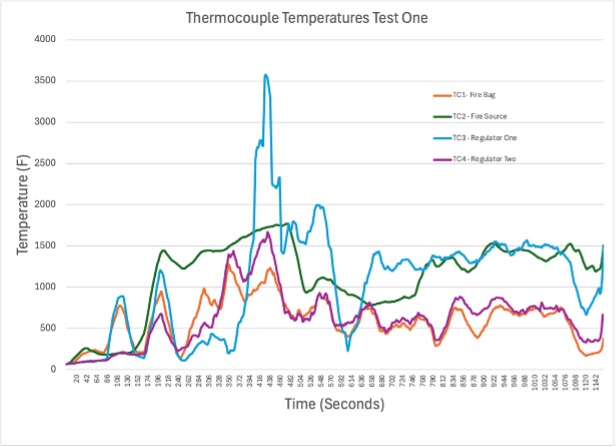
Thermal measurements from fire testing of residential gas meters and regulators exposed to a Class A fire. The Class A fire caused all tested gas regulators to fail and vent gas unless it was protected by the activated FireBag FSV. Upon failure of the gas regulator or meter, temperature measurements indicated substantial increases, with recorded temperatures reaching levels consistent with natural gas fires (Class B) that are significantly higher than those produced by Class A combustibles. [5]
Where Gas Fed Fire Risk Can Persist
- During a wildfire, natural gas can become a secondary fuel source before the primary-source is controlled. Fire damaged meter and regulator equipment may release high pressure gas while a utility is arranging or carrying out a system shutoff and in many wildfire cases individual meter isolation is not an option.
• Access is only one operational constraint: fire, debris, changing wind conditions, and incident-command restrictions can delay crews; the available records do not establish access as the only factor affecting response time.
• Automatic protection at the property can complement utility response. A thermally activated shutoff such as the FireBag® Fire Safety Valve (FSV) can automatically shut off gas at the exposure of fire.
FireBag Provides Automatic Shutoff at the Property
The FireBag Fire Safety Valve (FSV) uses a fusible alloy and spring mechanism to close automatically when its thermal element reaches 203–212°F. TECO Americas recommends installation upstream of the service regulator.
| Function | Utility Wildfire Response | FireBag FSV Automatic Shutoff |
|---|---|---|
| Area-wide response | Utility suspends service across the fire zone in coordination with first responders | Adds automatic shutoff at the property; broader utility isolation may still be needed |
| Individual site work | Crews must access and close meters, assess damage, repair equipment, and restore service when safe | Closes automatically when sufficiently heated; assessment and restoration still require qualified personnel |
| Timing | Depends on conditions and the operation; system isolation and individual meter closure are separate actions | Activation time is less than a minute once heat source reaches the thermal element. |
| Personnel at the site | Trained responders act according to conditions and incident coordination | No person is needed for activation; subsequent site work remains necessary but gas supply is secured to the meter set. |
| Dependencies | Access, crew availability, system configuration, and fire conditions | FSV Installation and sufficient heat exposure |
- FireBag adds a local automatic shutoff that can reduce the risk of gas feeding a fire before crews can reach the property. It complements system isolation and individual service shutoffs. Once the FireBag is triggered, it and any other damaged meter set components need to be replaced. [6]
FireBag Operation and Performance
- Triggers automatically at 203–212°F.
- No electricity or external electronic detector is required. A fusible thermal element releases a spring-loaded closure plug. [6]
- The TECO Americas datasheet specifies heat resistance of 1,500°F for 90 minutes at 150 psig. It The FireBag exceeds the international DIN 3586 benchmark of about 1,200°F for 30 minutes at 72.5 psig.
- No routine valve maintenance is required. An activated FireBag must be replaced before service is restored.
- Once the FireBag is triggered, it and any other damaged meter set components need to be replaced. [6]
- More than 500,000 FireBag units have been installed across North America.
Assessing Sites for Additional Protection
- TECO Americas identifies hospitals, schools, assisted living facilities, multi-unit residential buildings, and locations where meters may become inaccessible during a fire as immediate candidates for FSV deployment. Utilities should assess these locations within their own risk evaluations. [9]
• Area-wide response Utility suspends service across the fire zone in coordination with first responders. FSV minimizes broader utility isolation.
• Activation time is less than a minute once heat source reaches the thermal element.
• First Responders act according to conditions and incident coordination. No personnel required for gas system shutoff; allowing first responders to focus on life and property.
• FireBag adds a preventative maintenance solution to assist in controlling the unpredictability of a wildfire.
Talk to a FireBag specialist →
Request the FireBag Desk Reference →
TECO® Americas | (908) 488-0909 | inquiry@tecoamericas.com
Function Utility Wildfire Response FireBag FSV Automatic Shutoff
Area-wide response Utility suspends service across the fire zone in coordination with first responders Adds automatic shutoff at the property; broader utility isolation may still be needed
Individual site work crews must access and close meters, assess damage, repair equipment, and restore service when safe. The FireBag closes automatically when sufficiently heated; assessment and restoration still require qualified personnel.
Timing Depends on conditions and the operation. System isolation and individual meter closure are separate actions. Activation time is less than a minute once heat source reaches the thermal element.
Personnel at the site and trained responders act according to conditions and incident coordination No person is needed for activation; subsequent site work remains necessary but gas supply is secured to the meter set.
FireBag adds a local automatic shutoff that can reduce the risk of gas feeding a fire before crews can reach the property. It complements system isolation and individual service shutoffs. Once the FireBag is triggered, it and any other damaged meter set components need to be replaced.
FireBag Operation and Performance
Triggers automatically at 203–212°F.
No electricity or external electronic detector is required. A fusible thermal element releases a spring-loaded closure plug. [5]
The TECO Americas datasheet specifies heat resistance of 1,500°F for 90 minutes at 150 psig. It The FireBag exceeds the international DIN 3586 benchmark of about 1,200°F for 30 minutes at 72.5 psig. No routine valve maintenance is required. An activated FireBag must be replaced before service is restored.
• More than 500,000 FireBag units have been installed across North America.
Talk to a FireBag specialist →
Request the FireBag Desk Reference →
TECO® Americas | (908) 488-0909 | inquiry@tecoamericas.com
References
Sources reviewed September 12, 2026. Numbered references in the text correspond to the linked entries below. Product specifications and installation counts are attributed to the manufacturer.
1. Eaton Fire updates, January 10, 2025.
Individual shutoffs, planned system isolation, access restrictions, and customer warning.
2. Eaton Fire updates, January 11, 2025.
Eaton update records the January 11 shutoff affecting more than 16,700 customers.
3. Palisades and Eaton updates, January 12, 2025.
Meter closures and the service-restoration process.
4 Representative Friedman’s remarks, printed pages 47–48. (need to attach link)
5. Gas Meter Assembly Fire Exposure Testing, James A Lynch, The Fire Solutions Group LLC, York, PA 17401
May 13, 2026.
6. TECO Americas. FireBag product description.
7. TECO. FireBag installation manual, FIS006400_R0.1.
Installation, maintenance, replacement, and fire-resistance leakage criteria.
8. TECO Americas. FireBag datasheet, September 2, 2026.
Temperature, pressure, duration, and DIN benchmark specifications.
9. TECO Americas. Gas Utilities Adopt a Proven New Defense Against Escalating Wildfire Risk, May 26, 2026.
Manufacturer-reported installations, Doug Staebler statement, and proposed applications.
Conditional study requirement and discretionary risk-based rulemaking for valves or equivalent technologies.
Share This Story, Choose Your Platform!
Resources
Contact Us Today!
All information is confidential and sent directly to a TECO Americas representative.
TECO® Americas, LLC
263 Cox Street Roselle, NJ 07203
inquiry@tecoamericas.com
Phone: 908-488-0909
https://tecoamericas.com