
Congress Proposes PHMSA Evaluate Fire Shutoff Valves in Reauthorization Bill S.2975, Section 217 – PIPELINE Safety Act of 2025 – Part 1
One priority that unites Congress is improving fire safety and reducing threats to firefighters, residents, businesses, and property. PHMSA Rauthorization Bills are where Congress resets program priorities, updates statutory mandates, and sets policy direction.
Texas Senator Ted Cruz, Chair of the Commerce Committee, described the goal of the Reauthorization Bill: “The PIPELINE Safety Act of 2025 ensures oversight of the pipeline system is governed by appropriate, data-driven, and cost-effective standards.” The PHMSA reauthorization restores and sharpens Congressional oversight and steers PHMSA toward risk-based, cost-effective safety regulation.
Senators Cantwell and Cruz were joined by Michigan Senator Gary Peters, Ranking Member of the Commerce Subcommittee on Surface Transportation, Freight, Pipelines and Safety, and Indiana Senator Todd Young in introducing the bipartisan PIPELINE Safety Act of 2025 on October 6, 2025, with the stated intent to address known safety risks.
The bill passed the full Senate by voice vote on October 22, 2025. It must now be passed by the House of Representatives and signed by the President before it becomes law.
Broad Stakeholder Support
The bill has garnered support from several organizations, including:
- American Gas Association (AGA)
- American Petroleum Institute (API)
- American Public Gas Association (APGA)
- GPA Midstream Association
- Interstate Natural Gas Association of America (INGAA)
- Liquid Energy Pipeline Association (LEPA)
- The Pipeline Safety Trust (PST)
Proactive Measures Required by the Bill
Implementing the Use of Fire Safety Valves
During a structure fire, primary or secondary source natural gas can intensify the blaze leading to the potential for catastrophic outcomes, should the system continues to feed gas into the building. The reauthorization bill requires PHMSA to review and set new standards that would require utilities to install automatic Fire Safety Valves (FSVs) that stop gas flow when a fire occurs.
Fire Safety Valves prevent gas from feeding a Class A (structure) fire and increasing the intensity into a Class B (liquids or gas) fire.
“Section 217 (f) (1) (D) of the bill defines “Fire Shutoff Valves” as “a spring-loaded plug that is held in place by a fusible link that
(i) is made of a low-melting-point alloy;
(ii) is attached to a gas source; and
(iii) melts when exposed to fire, causing the spring-loaded plug to close, shutting off the gas to a dwelling or other building connected to a service line of a distribution system.”
S.29751 does not immediately mandate nationwide installation of fire shutoff valves. Instead, it adopts a “study first, then develop appropriate risk-based standards” approach.
Section 217(2) of the bill includes the following directive to study the efficacy of Fire Safety Valves:
“(A) IN GENERAL ‚ Not later than 2 years after the date of enactment of this subsection, the Secretary shall complete a study on the effectiveness of fire safety valves in order to determine the ability of fire safety valves to improve public safety through mitigation of secondary ignitions, such as fire-first ignitions.
“(B) REQUIREMENTS — The study under subparagraph (A) shall evaluate —
“(i) various scenarios and applications for deploying fire safety valves;
“(ii) the current incidence of fire-first ignition of natural gas distribution pipelines;
“(iii) anticipated reduction of fire-first ignition risk under various fire safety valve deployment scenarios, including:
“(I) lowering the likelihood of gas ignition; and
“(II) lowering the impact and damage of fire-first ignition incidents;
“(iv) the long-term durability, construction, and effectiveness of fire safety valves; and the commercial availability of fire safety valves for the pipeline industry.
”(3) RULEMAKING.‚ After completing the study described in paragraph (2), the Secretary may prescribe risk-based standards on the circumstances under which an operator of a natural gas distribution system shall be required to install fire shutoff valves or equivalent technologies in the system.
The bill also aims to amend 49 U.S.C. 60101 by adding a new subsection on fire shutoff valves and equivalent technologies.
Problem Fire Safety Valves Seek to Address
Preventing Class A Fires from Escalating to Class B Fires
In 2024, the York Pennsylvania based Fire Solutions Group, along with TECO Americas and the York County Fire Academy, conducted testing that demonstrated gas meters and regulators exposed to fire quickly fail and intensify the fire.
The main objective of this test series was to:
- Evaluate the impact of Class A burning materials on the components of a typical gas metering system used in commercial and residential settings.
- Demonstrate the effectiveness of a thermal-activated Fire Safety Valve (FSV), also referred to as a Thermal Activated Shutoff (TAS), in preventing natural gas from becoming an additional fuel source in a fire.
A Class A fire involves solid materials such as wood, paper, fabric, and some plastics. This is typical of a structure fire that may impact gas metering assets. Class B fires involve liquids or gases such as alcohol, ether, natural gas, or gasoline.

During testing, as the fire progressed and gas equipment failed due to exposure to a Class A fire, the incident escalated into a more severe Class B fire. This transition was driven by uncontrolled natural gas released from the regulator, which intensified the fire and significantly increased the risk of property damage, as well as the danger to first responders and occupants.
Key Findings from the Test Series
Seven distinct tests were conducted, each involving controlled ignition of Class A fuel around meter assemblies. The results showed:
Widespread failure of metering components under fire exposure
- Seven residential gas meters and nine gas regulators were exposed to Class A fire.
- All nine gas regulators failed in less than 3 minutes and released high-pressure gas unless protected by an activated FireBag FSV.
- All lines tested utilizing an FSV terminated gas service providing the needed safety feature to a gas regulator in a fire scenario.
Transition from Class A to Class B fires
 Upon regulator or meter failure, temperatures rose to levels consistent with natural gas fires (3,600 degrees), which are significantly higher than those from Class A combustibles (1,200 degree).
- Escaping gas intensified the fire and accelerated destruction of the meter set.
- In every test, the regulator failed within a few minutes once exposed to the Class A fire.
- If the gas supply was not shut off by the FireBag FSV, the regulator vented gas at a high flow rate, which increased fire temperature, melted the aluminum bodies of the regulator and meter, and damaged valves and insulated unions.
Meter failures also contributed to gas-fed fires
- In some tests, meters failed due to fire exposure and vented higher volumes of gas, further intensifying the fire when the TSV was not present upstream.
FireBag FSV Performance
- The FireBag FSV consistently activated and closed when exposed to fire-level heat, stopping gas flow in each test where it was installed.
- The FireBag FSV remained gas tight throughout the fire, and remained closed after cooling.
Conclusion from Testing
The test series confirms:
- Gas metering components (regulators and meters) fail quickly when exposed to the heat of a typical structure fire.
- These failures result in large volumes of venting gas that ignite, accelerate system destruction, and escalate the event from a Class A to a more hazardous Class B fire.
- Proactive shutoff of gas supply to the meter set is critical to preventing gas involvement and limiting fire severity.
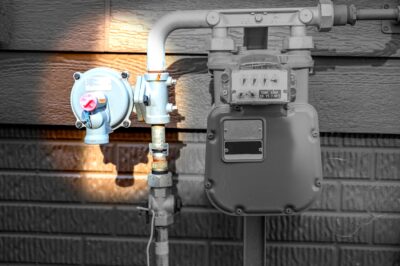
- Because manual shutoff valves are typically located on the riser within a few feet of the regulator and meter, reaching them during a fire requires working in hazardous conditions.
A properly located thermally activated FSV device upstream of the gas regulator and meter set is therefore essential to eliminate gas supply to metering components that are exposed to fire. Fire Shutoff Valve (FSV) technology is a key component for improving utility safety standards to protect customers, first responders, and in the gas industry.
1 S.2975 – PIPELINE Safety Act of 2025, Section 217
https://www.congress.gov/bill/119th-congress/senate-bill/2975/text#toc-ide425f215dc6e4b6ab5032f28f07a4ada
This is Part 1 of a two-part series on the PIPELINE Safety Act of 2025 and thermal shutoff valve technology. Part 2, coming next week, will explore case studies, and the benefits of regulatory adoption of Fire Shutoff Valves.
The PIPELINE Safety Act of 2025 (S.2975) is advancing critical fire safety protections for gas utilities nationwide. Thermal shutoff valve technology represents an important tool in our industry’s commitment to community safety and infrastructure resilience.
Is your utility ready to continue safety improvements? Share your perspective, implementation plans, or questions in the comments. Together, we can advance the standard for fire safety in natural gas distribution.
One Comment
Leave A Comment
Resources
Contact Us Today!
All information is confidential and sent directly to a TECO Americas representative.
TECO® Americas, LLC
263 Cox Street Roselle, NJ 07203
inquiry@tecoamericas.com
Phone: 908-488-0909
https://tecoamericas.com


This is a very interesting Bill, as there appears to be more and more fires this winter involving natural gas and propane resulting in more casualties, injuries and loss of property. The more safety technology in any industry that can be provided the better! Do you have a proposed plan for how this should be evaluated and rolled out?